Image
In 2009, Duke University created the first university-based offsets program in the United States. Duke retired, or used, 232,000 offsets from four different projects to achieve carbon neutrality in 2024. Read more about Duke's 2024 carbon offsets portfolio. Duke also achieved carbon neutrality in FY25, with carbon offsets.
Duke University rigorously evaluated and purchased carbon offsets to help meet its 2024 carbon neutrality goal and maintain carbon neutrality through FY25. Duke has experience developing its own, small-scale carbon offset projects ranging from urban forestry to swine waste-to-energy. These pilot projects are foundational to Duke’s approach to carbon offsets by gaining first-hand expertise through researching and managing projects within the carbon market. Leveraging this experience led to the implementation of a responsible carbon offsetting strategy that prioritizes real, additional emissions reductions from high-quality projects.
This strategy was a part of the reduce, renew, offset framework that guided the university’s approach to carbon neutrality in 2024 and 2025. This framework focuses first on quantifying and reducing Duke’s own emissions as much as possible, followed by investing in renewable energy to the extent logistically and financially feasible. Only once these first two efforts have been exhausted were carbon offsets used to address the emissions remaining in the university’s GHG accounting.
Operating within an academic institution, meaningful collaborations with students, faculty, and staff have been key to expanding understanding of the carbon market, carbon offset projects, and how offsets can be responsibly used to combat climate change. OCS served as clients on master's projects and the Design Climate program, helped lead Bass Connections projects, and presented in classes and at academic conferences, highlighting that collaboration with faculty and students around carbon offsets has always been a priority.
Duke used a portfolio approach to purchase carbon offsets from a wide variety of projects, which reduces risk when compared to investing in fewer projects. Different offset project types reduce different greenhouse gas types (e.g. methane or nitrous oxides), confer varying types and levels of co-benefits, and involve differing levels of risk to the project’s continuation. Duke’s portfolio included projects such as landfill gas destruction, swine waste-to-energy in North Carolina, community forestry, and the destruction of ozone depleting substances.
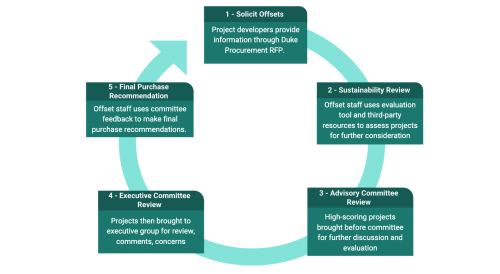
There are many projects of varying degrees of quality and legitimacy available for purchase in the voluntary offset market, where Duke operates. Duke considered offsets to be high quality if they were from projects that occurred due to carbon offset financing with carbon reductions or removals that are long-term, and did not adversely impact local communities or people. To facilitate the evaluation of offset projects, Duke created a robust evaluation process to review all potential offset projects before purchase.
Process for Evaluation included: